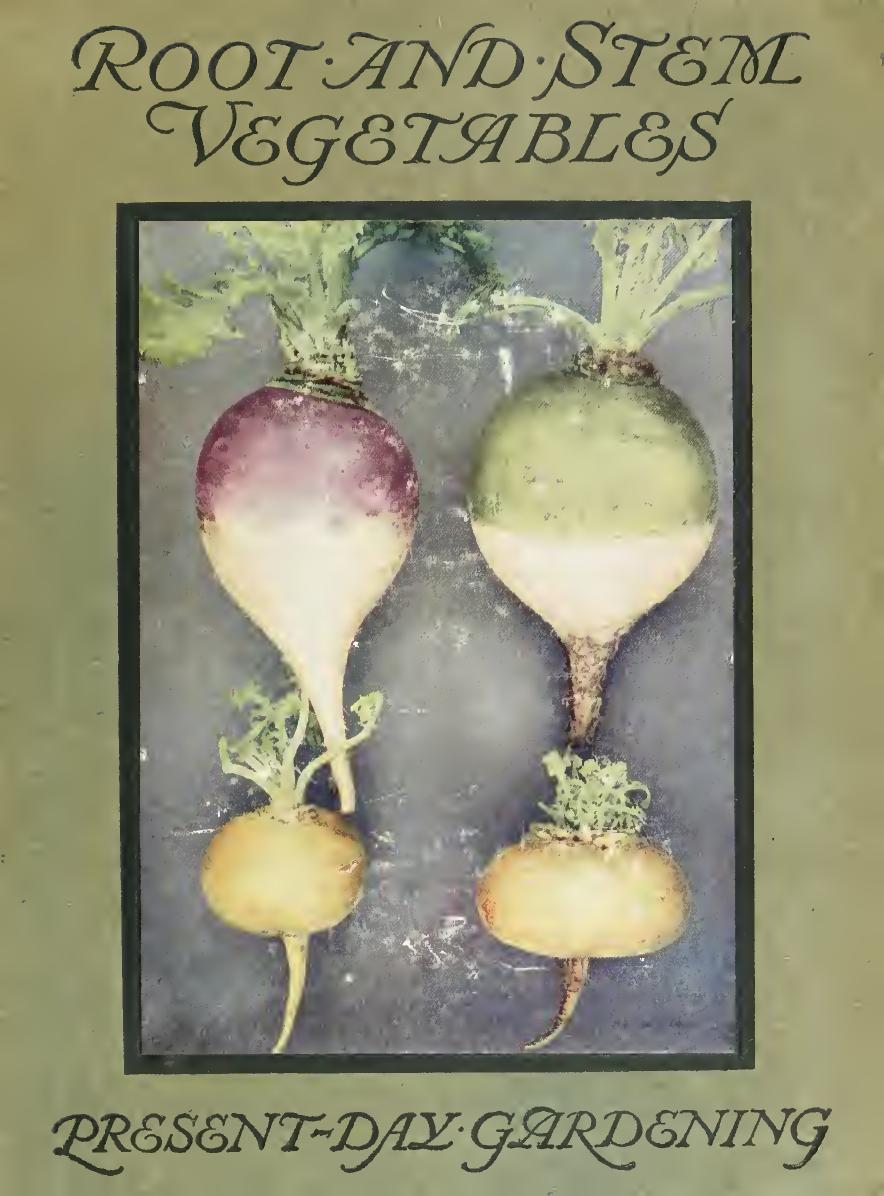
Root and stem vegetables by Dean Alexander
Author:Dean, Alexander
Language: eng
Format: epub, pdf
Tags: Vegetables
Publisher: London & Edinburgh, T. C. & E. C. Jack
Published: 1910-03-25T05:00:00+00:00
weather, it is necessary, after drawing the drills, to well soak them with water, then the moment that has soaked in, to sow the seeds, covering them thinly with fine dry soil. Growth will commence after a few days, and then it is desirable to dust the seedlings heavily with fine soot, dust, or wood ashes. The short grass mown from lawns, cast thinly along over the drills, helps to shade the seedlings from hot sunshine, and wards off that destructive insect, the Turnip Fly. The dustings should be repeated frequently if these insect pests abound. It is desirable to pull and store some roots in soil or ashes when hard weather is imminent. They can be laid in thickly in soil beneath trees, and sheltered with a covering of litter or fern fronds, or they can be stacked in dry soil in beds or stores. Where it is desired to give to young Turnips some stimulus, a liberal dressing of native guano greatly assists growth, if dusted along the drills when the seed is sown. Finely crushed sulphate of ammonia, nitrate of soda, or guano strewn beside the rows, at the rate of 3 lbs. per rod, and hoed in after growth has begun, also helps the plants to develop the roots rapidly. The quicker the growth, the sweeter and crisper the roots. Apart from the ordinary use of Turnips as a table vegetable, they are acceptable also for flavouring stews and soups.
SWEDE TURNIP {Brassica Rapd)
Some leading seedsmen have successfully made selections from the well-known yellow-fleshed Swede Turnip of the field, suitable for garden culture. Varieties with yellow flesh and white flesh, moderate in growth, are
70 PRESENT-DAY GARDENING
now obtainable. These roots are much hardier than the white or yellow garden Turnips ; hence a few rows in a garden may be found of special service in hard weather. Seeds of these varieties may be sown in June and July for succession, in drills i8 inches apart, on good, well-worked ground. To furnish a little protection, soil may be drawn up round the roots in November. When peeled and cooked, the flesh is of a soft, marrowy texture, and distinct and pleasant flavour, which many persons greatly like. Spare roots put close together in a bed of soil in a frame will furnish plenty of young shoots in the early spring, and these form an acceptable vegetable.
Holders of small farms, who cultivate their lands by gardening methods, are recommended to raise a breadth of a good variety of Swede each year. Apart from the value of the roots for the table, and the sprouts they are capable of producing in spring, any roots which are left growing all winter will make excellent food, either in a raw or cooked condition, for cattle, poultry, and pigs. There need be no waste of any kind in such a crop.
CHAPTER IV
BLANCHED-STEM VEGETABLES
ASPARAGUS {Asparagus officinalis)
The Asparagus is a native plant on the sea-coasts of Britain, and therefore perfectly hardy. The portion used as a
Download
This site does not store any files on its server. We only index and link to content provided by other sites. Please contact the content providers to delete copyright contents if any and email us, we'll remove relevant links or contents immediately.
The Secret History by Donna Tartt(19436)
Goodbye, Things by Fumio Sasaki(8681)
Wonder by R. J. Palacio(8219)
Turbulence by E. J. Noyes(8183)
How to Be a Bawse: A Guide to Conquering Life by Lilly Singh(7601)
The Thirst by Nesbo Jo(7081)
The Testaments by Margaret Atwood(7075)
Kaplan MCAT General Chemistry Review by Kaplan(7044)
The Last Wish (The Witcher Book 1) by Andrzej Sapkowski(5576)
Spare by Prince Harry The Duke of Sussex(5344)
The Body: A Guide for Occupants by Bill Bryson(5258)
The Rules Do Not Apply by Ariel Levy(5075)
On Writing A Memoir of the Craft by Stephen King(5046)
Audition by Ryu Murakami(5036)
The Doodle Revolution by Sunni Brown(4878)
1578 Plant Pattern Recognition Receptors by Unknown(4820)
Gerald's Game by Stephen King(4784)
Adulting by Kelly Williams Brown(4675)
Millionaire: The Philanderer, Gambler, and Duelist Who Invented Modern Finance by Janet Gleeson(4585)
